
Payslip Calculator & Compliance Checker
Calculate Your Salary Breakdown
See how your salary is broken down according to Indian labor laws. Enter your details below to calculate your net pay and identify missing components.
Your Payslip Analysis
Your calculated payslip will appear here after clicking 'Calculate Your Payslip'
Indian Labor Law Requirements
According to the Payment of Wages Act, 1936 and Code on Wages, 2019, your payslip must include:
- Employee name & ID Missing
- Pay period Missing
- Basic salary Present
- All allowances Missing
- Deductions (PF, ESI, tax) Missing
- Net pay Present
- Employer signature/stamp Missing
What to do if components are missing
If any required elements are marked as missing, you have the right to request a compliant payslip under Indian law. According to Section 21 of the Payment of Wages Act, employers must provide a written statement of wages. If they don't, you can file a complaint with the local Labor Department.
For more information: https://labour.gov.in or call 1800-11-1300
Every month, millions of employees in India receive a payslip. But do they have a legal right to one? Or is it just a nice gesture from the employer? The answer isn’t as simple as it sounds. Many workers assume their payslip is optional, and some employers treat it that way. But under Indian labor law, payslip isn’t just a formality-it’s a legal requirement.
What the Law Actually Says
The Payment of Wages Act, 1936, is the main law governing how employers pay workers in India. While it doesn’t use the word "payslip," it clearly states that every employer must provide a written statement of wages paid to each employee. This written statement is what everyone calls a payslip. It’s not optional. It’s not a company policy. It’s a statutory obligation.The law applies to all factories, mines, plantations, and other establishments employing 20 or more people. But even smaller companies aren’t off the hook. Many states have expanded this rule to cover all employers, regardless of size. For example, in Maharashtra and Tamil Nadu, the law requires payslips for every worker, no matter how small the business.
So if you’re working in India and you haven’t received a payslip, you’re being denied a legal right. Not because your employer is being stingy, but because they’re breaking the law.
What Must Be on a Legal Payslip?
A valid payslip isn’t just a number at the bottom. Indian law requires specific details to be included. If any of these are missing, the payslip doesn’t meet legal standards:- Employee name and ID
- Period covered (e.g., January 1-31, 2026)
- Basic salary
- All allowances (house rent, conveyance, medical, etc.)
- Deductions (PF, ESI, income tax, professional tax, loan repayments)
- Total amount paid
- Signature or stamp of the employer or authorized representative
Some employers try to cut corners by giving a single sheet with just the net pay. That’s not enough. The law requires transparency. Employees must be able to see exactly where their money came from and where it went.
For example, if your employer deducts ₹1,200 for PF but doesn’t show how much was contributed by you versus the company, that’s a violation. Same goes for professional tax-some states charge different rates depending on your income bracket, and you have a right to know how much was taken and why.
What Happens If an Employer Doesn’t Provide a Payslip?
Ignoring this rule isn’t a minor oversight. It’s a punishable offense. Under Section 21 of the Payment of Wages Act, employers who fail to issue wage statements can face fines up to ₹5,000 per employee for each violation. Repeat offenders can be fined more, and in extreme cases, face imprisonment.But fines aren’t the only risk. If a dispute arises-say, over unpaid overtime or incorrect PF contributions-the payslip is your first piece of evidence. Without it, proving your claim becomes much harder. Courts and labor departments treat payslips as official records. No payslip? You’re essentially working on trust alone.
Real-world example: In 2024, a labor tribunal in Bengaluru ruled in favor of 47 workers who were never given payslips. The employer had claimed they paid "cash in hand" and kept no records. The tribunal ordered back wages, compensation for emotional distress, and a fine of ₹2.1 lakh. The employer had no documentation to prove what they paid.

What About Informal Workers?
Not everyone in India works in a formal office. Millions work in construction, domestic help, delivery services, or small shops. Do they get payslips?The short answer: not always. The Payment of Wages Act doesn’t cover workers earning more than ₹24,000 per month (₹2,000 per month under older rules). Many informal workers fall outside this limit. But that doesn’t mean they’re powerless.
The Code on Wages, 2019-which is being phased in across states-aims to bring all workers under one umbrella. Once fully implemented, every worker earning up to ₹35,000 per month will be covered. That includes gig workers, part-timers, and daily wage laborers. The law will require written wage statements for all of them.
Until then, informal workers should still ask for a receipt or written record of payment. Even if it’s just a note on a piece of paper with date, amount, and signature, it’s better than nothing. In many cases, a signed receipt has been accepted as proof in labor disputes.
How to Get Your Payslip If Your Employer Refuses
If you’ve asked for your payslip and been ignored, here’s what to do:- Send a formal written request via email or letter. Keep a copy.
- If no response in 7 days, file a complaint with the local Labor Department. Most states have online portals for this.
- Use the Labour Department’s toll-free helpline (1800-11-1300) to report non-compliance.
- For larger workplaces, contact the Inspector under the Payment of Wages Act. They have the power to inspect records and impose penalties.
- If you’re part of a union, involve them. Collective pressure works.
There’s no waiting period. You don’t need to wait until you’re fired or underpaid. The moment you’re denied a payslip, you have the right to act.
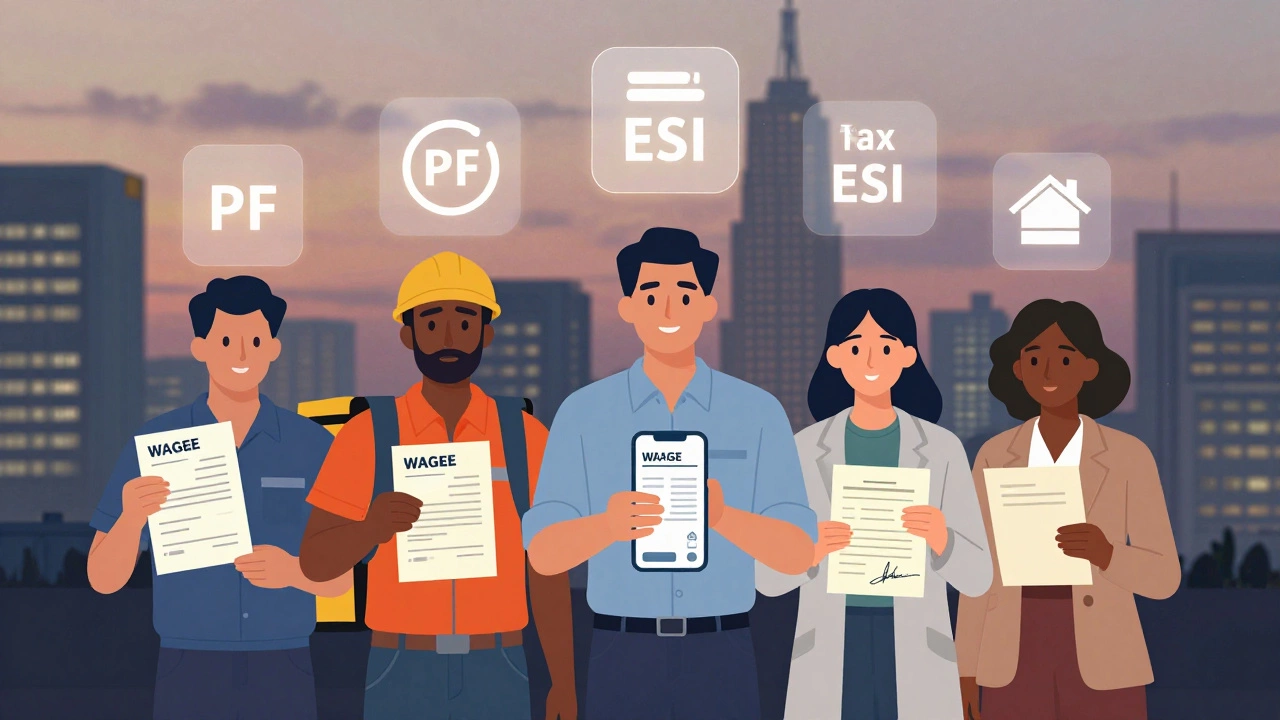
Why This Matters Beyond the Law
A payslip isn’t just about legality. It’s about dignity. It’s about knowing you’re being paid fairly. It’s about building credit. It’s about applying for a loan or renting an apartment. Banks and landlords often ask for three months of payslips. No payslip? No home loan. No rental agreement.It also protects you from fraud. Some employers inflate deductions, fake PF contributions, or hide overtime. A clear payslip stops that. It’s your record. It’s your proof.
And for employers? Providing payslips isn’t a burden-it’s a shield. It reduces disputes, builds trust, and proves compliance. Companies that do it right rarely face labor complaints.
What’s Changing in 2026?
By early 2026, most Indian states have fully implemented the Code on Wages. This means:- All employers, regardless of size, must issue payslips
- Digital payslips are now legally valid (email or app-based)
- Employers must keep wage records for at least three years
- Inspections are more frequent, and penalties are higher
Some states, like Karnataka and Gujarat, have launched apps where employees can download their payslips directly. Others require employers to upload wage data to state portals. This shift is making it harder to hide wage violations.
Final Takeaway
Yes, a payslip is mandatory in India. Not because the government wants to control you. But because the law recognizes that workers deserve transparency, accountability, and proof of what they’ve earned. Whether you work in a factory, an office, or on a delivery bike, you have the right to know exactly how your salary is calculated. And if your employer won’t give you one, you have the power to make them.Is it illegal to not give a payslip in India?
Yes, it is illegal. Under the Payment of Wages Act, 1936, every employer must provide a written statement of wages paid. Failure to do so is a punishable offense with fines up to ₹5,000 per employee and possible imprisonment for repeat violations.
Can an employer give a digital payslip instead of a printed one?
Yes. As of 2026, digital payslips sent via email or through employer portals are legally valid under the Code on Wages. The key requirement is that the employee receives a permanent, accessible record that includes all mandatory details like salary components, deductions, and net pay.
What if my payslip doesn’t show PF or ESI deductions?
That’s a violation. The law requires employers to clearly show contributions made to Provident Fund (PF) and Employees’ State Insurance (ESI). If these are missing, you should demand a corrected payslip. You can also check your PF account online through the EPFO portal to verify if contributions were actually made.
Do gig workers and freelancers get payslips?
Currently, gig workers earning above ₹24,000 per month are not covered under the Payment of Wages Act. However, under the Code on Wages (fully effective in 2026), workers earning up to ₹35,000 per month-including platform-based workers-are entitled to written wage statements. Employers must now provide them, even if they’re not traditional employees.
Can I file a complaint anonymously?
Yes. Most state labor departments allow anonymous complaints through their online portals. However, providing your details increases the chances of action. If you’re worried about retaliation, you can request confidentiality during the complaint process. The law protects workers from victimization for reporting wage violations.