
Adverse Possession Eligibility Checker
Evaluate Your Situation
Answer these questions honestly to determine if your case meets the strict legal requirements for Adverse Possession.
Ready to Evaluate
Select options above and click Analyze to see your eligibility score.
Result
Summary goes here.
You’ve been paying rent for two decades. The landlord hasn’t shown up in years. You’ve fixed the roof, painted the walls, and maybe even added a room. Now, you’re wondering: Do I own this place? It’s a common question among long-term tenants in India, especially in cities like Mumbai, Delhi, and Kolkata where rental markets are tight and informal agreements are the norm.
The short answer is: usually no. But there’s a legal concept called Adverse Possession, which is a legal doctrine that allows a person to claim ownership of land or property if they possess it openly, continuously, and without permission for a specified period that might change things-if you meet very strict conditions.
What Is Adverse Possession in Indian Law?
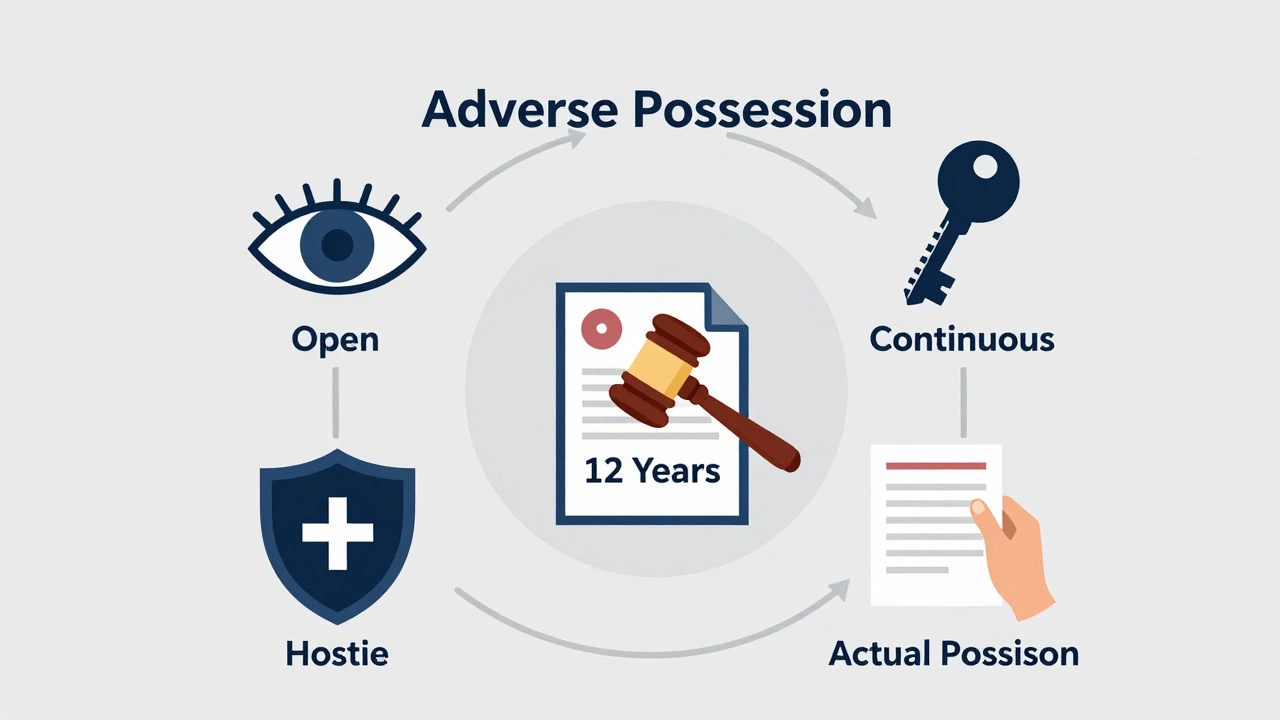
Adverse Possession under Limitation Act, 1963 is governed by Section 27 of the Limitation Act, 1963. This law says that if someone occupies another person’s property openly, hostilely (meaning against the owner’s wishes), and continuously for 12 years, they may file a suit to claim ownership.
Wait-12 years, not 20? Yes. In most cases across India, the statutory period is 12 years. However, some state-specific laws or older precedents might reference longer periods, which could explain why people talk about “20 years.” Still, the national standard remains 12 years.
But here’s the catch: being a tenant usually means your possession is permissive, not hostile. That’s the key word. If the landlord allowed you to live there-even silently-you don’t qualify for adverse possession. Your tenancy breaks the “hostile” requirement.
Why Tenants Rarely Qualify for Adverse Possession
To claim adverse possession, you must prove five elements:
- Open and Notorious: Everyone can see you’re living there. No hiding.
- Continuous: You haven’t left for more than a few months at a time over the 12-year span.
- Exclusive: You’re the only one controlling the property-not sharing with the owner or others.
- Hostile: You’re occupying it without the owner’s consent. This is the hardest part for tenants.
- Actual Possession: You’re physically using the land or building as an owner would.
If you signed a lease, paid rent regularly, or even just accepted keys from the landlord, courts will likely rule your possession was permissive. And permissive possession = no adverse possession claim.
In fact, many Indian High Courts have ruled that tenants cannot claim adverse possession unless they explicitly repudiated the landlord’s title-for example, by sending a formal notice saying, “I no longer recognize you as my landlord,” and then continuing to occupy the property openly.
Real-Life Example: The Mumbai Case That Changed Minds
In 2018, the Bombay High Court heard a case where a family had lived in a house for 25 years after their original lease expired. They claimed adverse possession. The court dismissed the case because they continued paying “rent” informally to relatives of the original owner. Even though payments weren’t official, the court saw them as acknowledgment of the owner’s title.
This shows how fragile adverse possession claims are for tenants. One small gesture-like paying money labeled as “maintenance” or “utility share”-can destroy your entire case.
State-Specific Rent Control Laws Matter Too
India doesn’t have a single national tenancy law. Each state has its own rules. For example:
| State | Rent Control Act | Eviction Difficulty | Adverse Possession Relevance |
|---|---|---|---|
| Maharashtra | Maharashtra Rent Control Act, 1999 | Very Hard | Low - strong tenant protections reduce need for adverse possession claims |
| Delhi | Delhi Rent Control Act, 1958 | Hard | Medium - older properties often lack clear records, increasing ambiguity |
| Karnataka | Karnataka Prevention of Eviction from and Enhancement of Rent of Residential Premises Act, 1999 | Moderate | Low - modernized laws favor landlords in dispute resolution |
| Tamil Nadu | Tamil Nadu Buildings (Lease and Rent Control) Act, 1960 | Hard | Medium - historic cases show mixed outcomes for long-term occupants |
In states like Maharashtra and Delhi, tenants are so well-protected that eviction is nearly impossible without cause. So why risk a risky adverse possession lawsuit when you can stay put legally?
When Might a Tenant Actually Succeed?
There are rare exceptions. Here’s what they look like:
- No Written Agreement Ever Existed: You moved in verbally, never signed anything, and the landlord disappeared.
- You Stopped Paying Rent Publicly: Not just stopped paying-but announced it. Sent letters. Told neighbors. Made it known you didn’t owe anyone anything.
- Landlord Tried to Evict You but Failed: If the landlord filed an eviction petition and lost, or abandoned the effort, that strengthens your “hostile” stance.
- You Improved the Property Significantly: Added structures, changed layout, invested heavily. Courts sometimes view this as evidence of ownership intent.
Even then, success isn’t guaranteed. You’ll need lawyers, documentation, witness testimonies, and possibly decades-old utility bills proving continuous occupancy.
What Should You Do Instead of Claiming Ownership?
Before suing for ownership, consider these safer paths:
- Negotiate a Buyout: Offer the landlord a fair price based on current market value. Many owners prefer cash over litigation.
- Formalize Your Tenancy: Sign a new lease with better terms. Lock in low rent for 5-10 years.
- Register Your Occupancy: Some local municipal offices allow long-term residents to register occupancy status, giving you legal recognition without owning the deed.
- Seek Mediation: Use community mediators or legal aid clinics to resolve disputes amicably.
These options avoid the stress, cost, and uncertainty of court battles-and keep relationships intact.

Common Misconceptions About Tenant Ownership
Let’s bust some myths:
- Myth: “If I pay rent for 20 years, I own it.”
Truth: Payment proves tenancy, not ownership. Unless you stopped paying AND declared independence from the landlord, you’re still a tenant. - Myth: “The landlord forgot about me, so I’m safe.”
Truth: Silence ≠ abandonment. Landlords can reclaim property anytime unless barred by statute of limitations-which rarely applies to residential leases. - Myth: “I built an extension, so I own that part.”
Truth: Unauthorized improvements belong to the landlord unless agreed otherwise. You might get compensation, but not title.
How to Protect Yourself as a Long-Term Tenant
If you’re worried about losing your home, take proactive steps now:
- Document Everything: Keep copies of all communications, payment receipts, repair invoices, and photos showing changes you made.
- Get Witness Statements: Neighbors, shopkeepers, or relatives who can testify you’ve lived there continuously help build your case-if needed.
- Consult a Local Lawyer: Property laws vary wildly between states. A lawyer familiar with your city’s recent judgments can give realistic advice.
- Check Municipal Records: See if your name appears in tax records, voter rolls, or water/electricity accounts. These support continuity of residence.
Final Thoughts: Don’t Gamble With Ownership Claims
Claiming ownership through adverse possession is a high-risk strategy for tenants. Most fail because they can’t prove hostility-or worse, they accidentally admit permissive possession during trial.
Instead of betting everything on a courtroom gamble, explore negotiation, mediation, or formalizing your tenancy. Your peace of mind-and your home-are worth more than a theoretical chance at ownership.
Can a tenant become owner after 12 years in India?
Only if they meet all criteria for adverse possession: open, continuous, exclusive, and hostile possession for 12 years. Most tenants fail because their possession is considered permissive due to prior agreement or rent payments.
Does paying rent prevent adverse possession?
Yes. Regular rent payments-even informal ones-are seen as acknowledgment of the landlord’s title, breaking the “hostile” element required for adverse possession.
What happens if the landlord dies and no heir claims the property?
You still can’t automatically claim ownership. Heirs inherit rights, and the limitation clock resets when any heir asserts claim. You’d need to wait another 12 years from that point while maintaining hostile possession.
Is there any state where tenants gain ownership after long stay?
No state grants automatic ownership to tenants. All follow the Limitation Act’s 12-year rule for adverse possession, which rarely favors tenants due to the “hostility” requirement.
Should I stop paying rent to start claiming ownership?
Not recommended. Simply stopping payment isn’t enough-you must publicly repudiate the landlord’s title. Otherwise, you risk eviction for non-payment without gaining ownership rights.