
Civil Law Category Identifier
Step 1: Select Your Situation
Click on the scenario that best describes your issue:
Analysis Result
Select a scenario on the left to see the legal classification and explanation.
Imagine you are in a courtroom. There is no judge banging a gavel to send someone to prison. Instead, two neighbors are arguing over a fence line, or a business owner is suing a contractor for shoddy work. This isn't criminal court; this is civil law, which deals with disputes between individuals or organizations rather than crimes against the state. If you have ever wondered why some lawsuits end with money changing hands instead of jail time, understanding the four pillars of civil law is your first step.
Civil law might sound like one big bucket of legal trouble, but it is actually divided into distinct categories. Each category has its own rules, standards of proof, and typical outcomes. Knowing which type of case you are dealing with can save you time, money, and a lot of headache. Let’s break down the four most common types: contracts, torts, property, and family law.
1. Contract Law: The Backbone of Business and Daily Life
You probably sign more contracts than you realize. When you click "I Agree" on an app’s terms of service, buy a house, or even hire a plumber to fix your sink, you are entering into a contract. In legal terms, a contract is a promise that the law will enforce if broken.
Contract law governs these agreements. It ensures that when one party fails to do what they promised, the other party has a remedy. This is crucial because without it, trust would collapse in both personal relationships and global commerce.
| Element | Description |
|---|---|
| Offer | One party proposes specific terms (e.g., "I will paint your house for $500"). |
| Acceptance | The other party agrees to those exact terms without changes. |
| Consideration | Something of value is exchanged (money, services, goods). |
| Capacity | Both parties must be legally able to contract (not minors, mentally competent). |
When a contract is breached, the injured party usually seeks "damages." This means the court orders the breaching party to pay money to cover the loss. For example, if a vendor cancels your wedding cake order last minute, and you have to buy a more expensive replacement, contract law helps you recover that difference. The goal here is not to punish the vendor, but to put you back in the financial position you would have been in had the contract been honored.
2. Tort Law: When Someone Harms You or Your Property
If contract law is about broken promises, tort law is about wrongful acts that cause harm. A "tort" is a fancy legal word for a civil wrong. Unlike contracts, there is no prior agreement between the parties. One person simply did something that hurt another.
Torts are generally split into three sub-categories:
- Negligence: This is the most common tort. It happens when someone fails to act with reasonable care, causing injury. Think of a car accident where a driver runs a red light, or a grocery store that doesn’t clean up a spill, causing a customer to slip. To win a negligence case, you must prove the defendant owed you a duty of care, breached that duty, and caused your injury.
- Intentional Torts: These involve deliberate actions meant to cause harm. Examples include assault, battery, defamation (libel or slander), and trespassing. If someone spreads false rumors about your business that cause you to lose clients, that is an intentional tort.
- Strict Liability: In these cases, intent or negligence doesn’t matter. If you engage in inherently dangerous activities (like keeping wild animals or using explosives) and someone gets hurt, you are liable regardless of how careful you were.
The outcome in tort cases is often monetary compensation for medical bills, lost wages, pain and suffering, or property damage. Personal injury lawsuits fall squarely under this umbrella.

3. Property Law: Rights Over Land and Assets
Property law sounds simple-"It’s mine, not yours"-but it is surprisingly complex. It covers everything from real estate (land and buildings) to personal property (cars, jewelry, intellectual property). Property law defines how ownership is acquired, transferred, and protected.
Common civil disputes in this area include:
- Boundary Disputes: Neighbors arguing over where one yard ends and another begins. This often requires surveyors and historical deed analysis.
- Easements: A right to use someone else’s land for a specific purpose, like a driveway access road. If a neighbor blocks your easement, you can sue in civil court.
- Zoning Violations: Disagreements between homeowners and local governments about what can be built on a piece of land.
- Foreclosure and Eviction: While these involve housing, they are civil matters concerning the right to possess property based on contractual failures (non-payment of rent or mortgage).
In property cases, courts may order "injunctive relief," meaning they force someone to stop doing something (like tearing down a shared wall) or to do something (like removing a fence). Monetary damages are also common if the property was damaged or devalued.
4. Family Law: Legal Relationships and Domestic Matters
Family law deals with the legal aspects of family relationships. It is highly emotional and deeply personal, yet it remains firmly within the civil system. Family law covers marriage, divorce, child custody, adoption, and domestic violence protections.
Unlike contract or tort cases, family law courts often prioritize the "best interests of the child" or equitable distribution of assets rather than strict fault. Key areas include:
- Divorce and Separation: Dissolving a marriage legally and dividing assets, debts, and spousal support.
- Child Custody and Support: Determining who makes decisions for the child and how much money the non-custodial parent must contribute.
- Adoption: Legally establishing a parent-child relationship for a child who is not biologically related to the parents.
- Paternity: Establishing legal fatherhood, which impacts custody and support obligations.
Because family law involves ongoing relationships, settlements are often negotiated through mediation before going to trial. Courts aim for stability and fairness, recognizing that these decisions affect people’s daily lives for years to come.
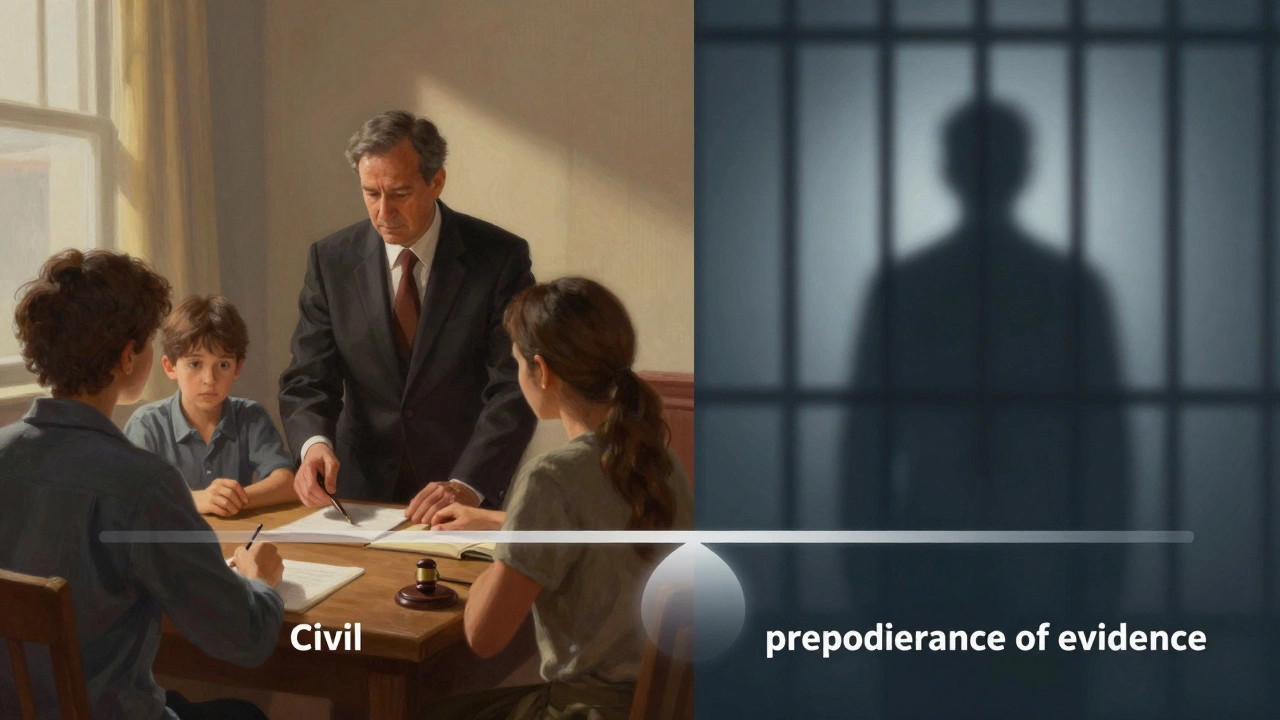
How Civil Cases Differ from Criminal Cases
It is easy to confuse civil and criminal law, especially when a single event triggers both. For instance, if someone assaults you, they can be prosecuted by the state (criminal) and sued by you for damages (civil tort). Here is how to tell them apart:
| Feature | Civil Law | Criminal Law |
|---|---|---|
| Who Brings the Case? | An individual or organization (Plaintiff) | The government (Prosecutor) |
| Goal | Compensation or specific performance | Punishment (jail, fines paid to state) |
| Standard of Proof | Preponderance of evidence (more likely than not) | Beyond a reasonable doubt (very high certainty) |
| Outcome | Money damages, injunctions, custody orders | Imprisonment, probation, criminal record |
The lower standard of proof in civil cases ("preponderance of evidence") means you only need to show that it is more likely than not (51%) that the defendant is responsible. In criminal cases, the state must prove guilt nearly 100%. This is why O.J. Simpson was acquitted in criminal court but found liable in a subsequent civil trial for the same deaths.
Why Understanding These Categories Matters
Knowing which type of civil law applies to your situation helps you set realistic expectations. Are you trying to enforce a promise? Look at contract law. Did someone hurt you? Look at torts. Is it about land or assets? Property law. Is it about family dynamics? Family law.
Each path requires different evidence, different legal strategies, and sometimes different lawyers. Misclassifying your issue can lead to wasted resources and missed deadlines. For example, filing a breach of contract claim when you actually have a negligence tort could mean missing critical statutes of limitations.
Civil law is designed to resolve conflicts peacefully and fairly. Whether you are a small business owner, a homeowner, or a parent navigating divorce, understanding these four pillars empowers you to navigate the legal system with confidence.
What is the difference between civil and criminal law?
Civil law deals with disputes between individuals or organizations, usually resulting in monetary compensation or specific actions. Criminal law involves the government prosecuting someone for breaking laws that harm society, often resulting in jail time or fines paid to the state.
Can one incident result in both civil and criminal cases?
Yes. For example, a drunk driving accident can lead to criminal charges (DUI) brought by the state and a civil lawsuit (personal injury/tort) filed by the victim for damages. The outcomes are independent of each other.
What does "preponderance of evidence" mean?
It is the standard of proof used in civil cases. It means that the claim is more likely true than not true (greater than 50% probability). This is a lower bar than "beyond a reasonable doubt" used in criminal trials.
Is family law considered civil law?
Yes. Family law is a major branch of civil law. It handles private disputes regarding marriage, divorce, child custody, and adoption, rather than crimes against the public.
What are the main remedies in civil cases?
The most common remedy is monetary damages (compensatory or punitive). Courts may also issue injunctions (orders to do or stop doing something) or specific performance (forcing a party to fulfill a contract).