When a marriage ends in India, one of the most confusing questions couples face is: Is a husband liable for his wife’s debt? The answer isn’t simple. It depends on when the debt was taken, why it was taken, and whether it was for shared benefit. Many people assume that marriage means shared financial responsibility - but Indian law doesn’t work that way by default.
Debt in Marriage: Not Automatically Shared
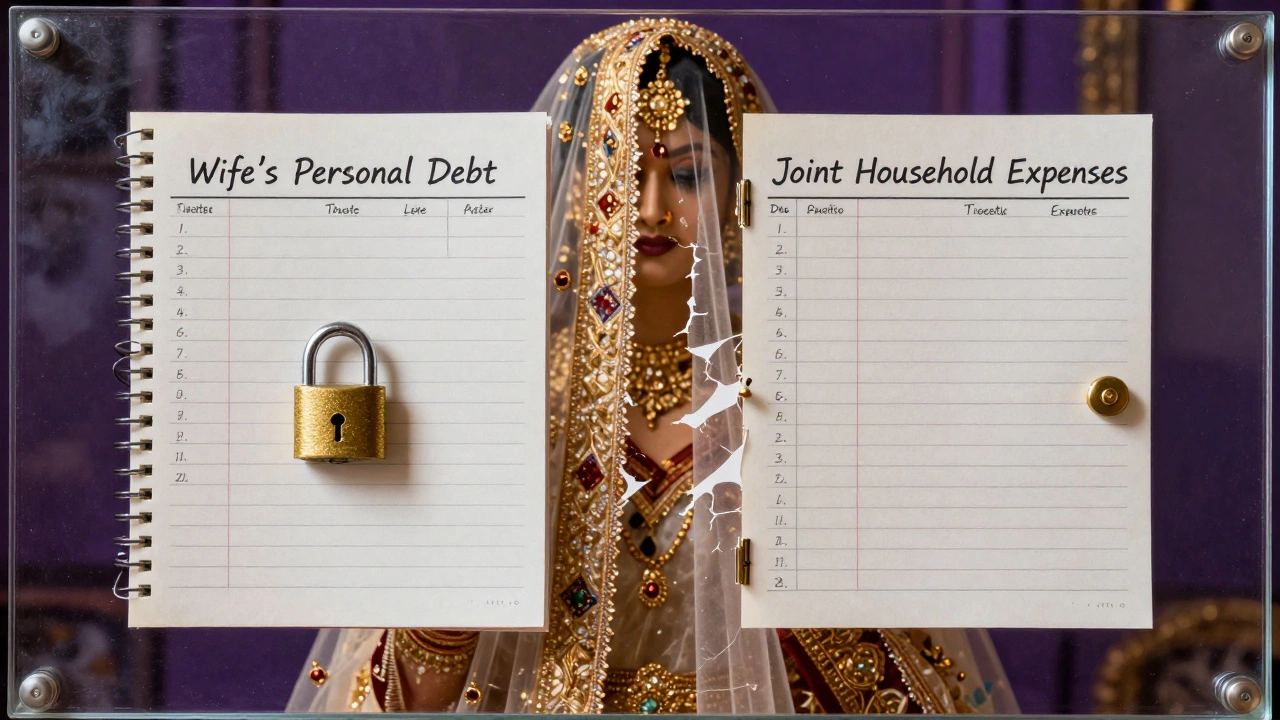
In India, marriage doesn’t turn two individuals into one legal financial unit. Unlike some countries with community property systems, Indian law treats spouses as separate legal entities. This means a wife’s personal debt - like a credit card she opened in her name alone, a personal loan for her business, or medical bills from an emergency - is not automatically the husband’s responsibility.
There’s a common myth that if you marry someone, you inherit their debts. That’s not true under Indian law. The Indian Contract Act, 1872 and the Hindu Marriage Act, 1955 don’t create automatic liability between spouses for debts incurred before or during marriage. A husband can’t be forced to pay his wife’s personal loans just because they’re married.
When Can a Husband Be Held Responsible?
There are exceptions. A husband can be held liable if:
- The debt was taken jointly - both names on the loan, credit card, or agreement.
- The money was used for family needs - like paying for children’s education, medical treatment for the household, or home repairs.
- The husband gave written consent or co-signed the loan.
- The debt was incurred under duress or fraud, and the husband benefited from it.
For example, if a wife took out a ₹5 lakh personal loan to start a tailoring business and used the profits to support the family, courts may consider that debt as benefiting the household. In such cases, a husband might be asked to contribute during divorce settlements - not because he’s legally responsible, but because the court considers fairness under Section 25 of the Hindu Marriage Act.
What About Pre-Marriage Debt?
Debts a wife had before marriage - like student loans, car loans, or credit card balances - are almost never the husband’s responsibility. Courts have consistently ruled that pre-marital debt stays with the person who incurred it. A 2022 ruling by the Delhi High Court held that a husband could not be forced to repay his wife’s ₹3 lakh student loan taken five years before marriage, even though they lived together for six years after.
But here’s the catch: if the husband starts paying off that pre-marriage debt voluntarily - say, by transferring money each month to help her pay it off - and it becomes part of the household’s financial pattern, courts might later treat it as a shared obligation during divorce proceedings. It’s not automatic, but behavior matters.

Section 25 of the Hindu Marriage Act - Maintenance vs. Debt
Many confuse alimony with debt liability. Section 25 allows a court to order one spouse to pay maintenance to the other if they lack sufficient income. But maintenance is not the same as paying off debts.
For instance, if a wife has ₹10 lakh in credit card debt and no income, the court may order the husband to pay her monthly maintenance - say ₹25,000 - so she can manage her life. But the court won’t order him to pay the ₹10 lakh debt directly. She still owes the bank. He only pays for her upkeep.
However, if the court finds that the debt was incurred for family purposes, it may factor that into the maintenance amount. For example, if the debt was used to pay for a child’s surgery, the court might increase maintenance to account for that burden.
What If the Debt Was Taken Under Coercion?
If a wife was pressured, threatened, or manipulated into taking a loan - and the husband knew about it and benefited - courts can treat it as a joint liability. The Indian Evidence Act, 1872 allows courts to consider circumstances of coercion or undue influence.
A real case from 2023 involved a woman who was forced by her in-laws to take a ₹20 lakh loan to buy a car for her husband’s business. She didn’t sign the papers willingly. When she filed for divorce, the court ruled the debt was invalid because it was taken under coercion, and the husband had to repay it since he was the primary beneficiary.
What About Muslim and Christian Couples?
India has personal laws based on religion. For Muslim couples, the Shariat Application Act governs financial matters. Under Sharia, a husband is expected to provide for his wife’s needs - food, shelter, medical care - but not necessarily her personal debts. If she takes a loan for non-essential items, he’s not liable.
For Christian couples, the Indian Divorce Act, 1869 applies. Similar to Hindu law, there’s no automatic debt transfer. But courts often look at whether the debt was incurred for joint benefit. If a Christian wife took a loan to fund a family vacation or a child’s tuition, the husband may be asked to share responsibility.
Practical Tips for Couples
- Keep financial records separate. Don’t mix personal and joint accounts unless you’re both clear on the purpose.
- Never sign loan documents for your spouse unless you fully understand the terms and intend to repay.
- If you’re helping with debt repayment, document it as a gift or loan - don’t assume it’ll be forgiven later.
- During separation, avoid making payments toward your spouse’s personal debts - it could be used against you later.
- Consult a divorce lawyer before agreeing to any financial settlement that includes debt assumption.
What Happens in Divorce Proceedings?
During divorce, courts don’t automatically divide debts like assets. Debts are assessed based on:
- Who took the loan?
- Was it for personal use or family benefit?
- Did both spouses benefit?
- Is there evidence of consent or co-signing?
For example, if a wife took a ₹15 lakh loan to pay for her sister’s wedding, and the husband never benefited, he won’t be asked to pay it. But if she took the same loan to pay for their honeymoon or to renovate their home, the court may divide it fairly.
Some couples try to hide debt during divorce. That’s risky. Courts can demand bank statements, loan documents, and even phone records. If a spouse is found to have concealed debt, it can hurt their credibility and affect maintenance or property division.
Final Word: Debt Is Not a Marriage Sentence
Marriage in India doesn’t mean you inherit each other’s financial mistakes. You’re not legally responsible for your spouse’s personal debts - unless you agreed to them, benefited from them, or signed the paperwork. The law protects individual financial autonomy.
That said, fairness matters. If a debt helped build a life together, courts may ask both parties to share the burden. But that’s based on evidence and context - not on the fact that you said "I do."
If you’re facing divorce and worried about your spouse’s debt, get legal advice early. Don’t assume liability. Don’t pay debts you didn’t agree to. And don’t let fear make you sign something you don’t understand.